
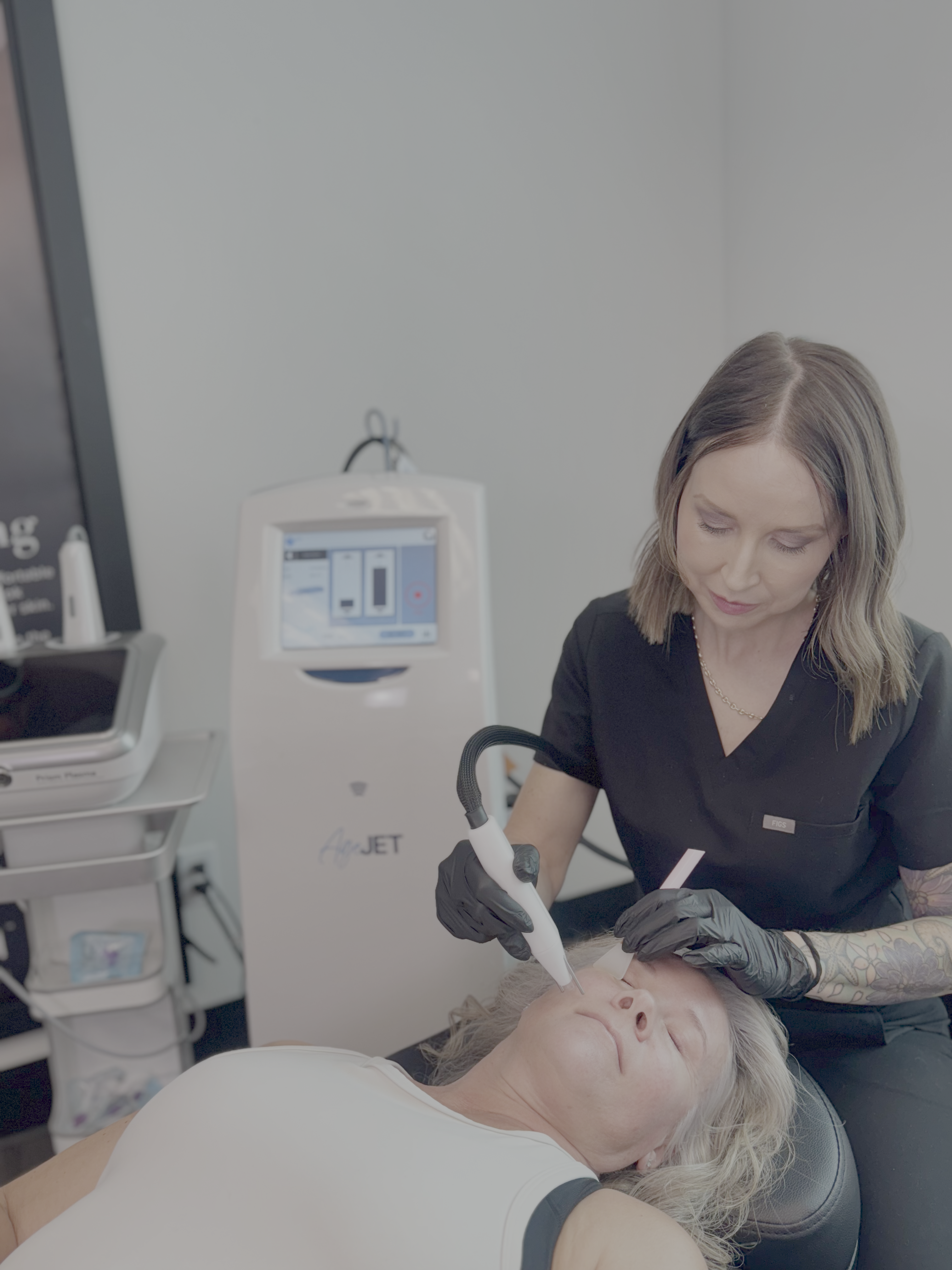
AgeJet Before and After: Real Results and Recovery
Before and after photographs are the most persuasive evidence in aesthetic medicine and the easiest to misread. Lighting, camera angle, distance from the lens, and the six weeks of sunscreen a patient started wearing between the two frames can account for a meaningful share of what looks like a dramatic change.
AgeJET rewards a closer look for exactly that reason. The change it produces is structural, built into the dermis rather than applied to the surface, which means it tends to hold up under scrutiny. The tradeoff is timing: results arrive on a slower schedule than most patients expect, and recovery varies more than the marketing usually admits. This guide covers what AgeJET skin resurfacing in Hillsboro, OR actually changes, when those changes become visible in a photograph, and what the days after a session involve.
What does AgeJET do beneath the skin?
AgeJET converts medical-grade nitrogen gas into plasma using an ultra-high frequency generator, then delivers that plasma to the skin in controlled pulses. The energy heats the dermis to a therapeutic range while the outer layer of skin stays intact. That single design decision explains most of what follows, from the shape of the results to the shape of the recovery.
Heat in the dermis triggers a wound-healing cascade without an open wound. Fibroblasts lay down new type I and type III collagen, elastin production increases, and the existing collagen scaffold contracts. Because the plasma treats the entire field rather than isolated columns of tissue, improvement appears uniformly across the treated area instead of in a stippled pattern.
The intact epidermis also does practical work during healing. It functions as a biological dressing over the regenerating tissue below, which lowers infection risk and makes the recovery period more predictable than open resurfacing.
What do AgeJet before and after photos actually show?
Four categories of change tend to appear in AgeJET comparison sets, and each one arrives on its own timeline.
Texture comes first in visual terms. Enlarged pores and crepey skin smooth out as the dermis thickens, and this is usually the most photogenic change because it alters how light scatters across the surface.
Tone follows closely behind. Sun damage and post-inflammatory pigmentation fade as the treated epidermis sheds and is replaced, often within the first two weeks. Patients dealing primarily with brown spots and vascular redness sometimes get further with IPL and ADVATx laser treatment in Hillsboro, so the two are worth comparing at consultation.
Contour is the slowest of the four. Laxity along the jawline and the neck improves as collagen contracts and rebuilds, but it rarely looks convincing before the three-month mark. Serious clinics photograph their contour cases at 90 days rather than 30 for this reason.
Scarring changes last. Rolling acne scars and shallow boxcar scars fill gradually as new collagen forms inside the scarred tissue, and the difference between a four-week photo and a six-month photo of the same cheek can be substantial.
How to read a before and after photograph Check that both images use the same lighting setup, the same distance from the lens, the same expression, and ideally the same time of day. Then ask two questions: how long after treatment was the second photo taken, and was this a single session or a series? A comparison set that omits the interval is difficult to interpret in either direction. |
When do AgeJet results appear?
Some tightening is visible the moment the session ends, driven by thermal contraction of existing collagen. That early effect softens over the following week as inflammation resolves, then rebuilds as new collagen forms. Patients who judge their outcome at day ten frequently conclude the treatment failed, when what they are actually looking at is the trough between two different mechanisms.
The clinical literature supports the delayed timeline. In a study published in Archives of Dermatology, eight volunteers received three low-energy full-face plasma skin regeneration treatments spaced three weeks apart. At the three-month follow-up, investigators recorded a 37% reduction in facial rhytids, while participants rated their overall facial appearance as 68% improved. Biopsies taken at 90 days showed a new band of collagen at the dermoepidermal junction averaging 72.3 micrometres deep (Bogle, Arndt & Dover, 2007).
Timeframe | What is visible |
|---|---|
Immediately | Warmth, mild flushing, and a subtle tightening effect across the treated field |
Days 1 to 3 | Redness and light swelling, comparable to brief sun exposure |
Days 3 to 7 | At deeper settings, a bronzed appearance that gives way to fine shedding |
Weeks 2 to 4 | Pigment clears, pores look finer, and skin texture refines noticeably |
Months 2 to 3 | Collagen remodelling becomes visible as firmness and improved definition |
Months 3 to 6 | Gradual continued improvement; the most meaningful window for comparison photos |
Most patients notice visible improvement after one session. Where the goal is significant rejuvenation rather than maintenance, a series spaced four to six weeks apart is generally recommended.
What does AgeJet recovery actually involve?
Recovery scales with the energy setting your provider selects, and the range is wider than most patients realise before they sit down for a consultation.
At low energy settings, suited to maintenance work and delicate areas, redness and mild swelling typically last somewhere between 12 and 72 hours. Makeup usually goes back on the following day and social downtime is negligible.
At higher settings, used for deeper wrinkles, acne scarring, and meaningful laxity, treated skin develops a bronzed appearance over the first two or three days and then sheds. The old epidermis lifts away in fine flakes rather than peeling in sheets, and the fresh surface underneath stays pink for several days after that. Patients treated at these settings generally plan for five to ten days before they feel comfortable in a meeting without makeup.
Location matters as much as intensity. The neck, chest, and backs of the hands re-epithelialise more slowly than the face because they carry fewer adnexal structures to drive the process, so a neck treated at the same energy as a cheek will take longer to settle. Skin that has already been through one plasma cycle also tends to recover faster on subsequent sessions than it did the first time.
Energy setting is a scheduling decision Downtime is chosen, not imposed. A patient with an event in ten days and a patient with an open month are candidates for different settings, and both can be treated well. Bring your calendar to the consultation; it is a legitimate input into the treatment plan. |
Which areas show the clearest before and after change?
Versatility is one of the practical arguments for plasma resurfacing, and some areas photograph better than others.
- Upper and lower eyelids, which can be treated without ocular shields and produce a non-surgical blepharoplasty effect that is difficult to achieve with other energy devices
- The perioral area, where vertical lip lines respond to collagen rebuilding without adding volume or affecting lip function
- Neck and chest, where crepiness and accumulated sun damage sit outside what injectables can reach
- Cheeks with rolling or shallow boxcar acne scarring, treated across the full field rather than fractionally
- Backs of the hands, where thinning skin and solar lentigines usually appear together
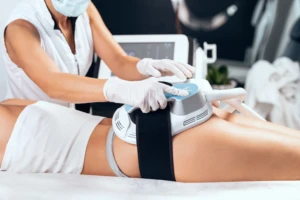
Body applications extend to the abdomen, arms, knees, and thighs, where post-weight-loss crepiness, pregnancy-related skin changes, and age-related thinning respond to the same collagen remodeling process. At Epion Aesthetics & Wellness, we often combine AgeJet with EMSCULPT NEO when patients are looking to improve both skin quality and the underlying muscle. While AgeJet stimulates collagen to improve firmness, texture, and crepey skin, EMSCULPT NEO builds muscle and reduces fat beneath the surface. Addressing multiple layers of tissue often creates a more comprehensive result than treating the skin alone. AgeJET Intimate also addresses laxity in delicate tissue without incisions.
How does AgeJet compare with other resurfacing options?
Plasma sits in a specific position among the technologies available at Epion, and understanding where the boundaries fall makes the consultation more productive.
Treatment | Mechanism | Typical downtime | Strongest for |
|---|---|---|---|
AgeJET | Nitrogen plasma heats the dermis while the surface stays intact | 48 hours to 10 days by setting | Wrinkles, laxity, acne scars, pigment, eyelid skin |
Microneedling | Controlled mechanical micro-injury at set depth | 1 to 3 days | Texture, early lines, mild scarring |
Attiva | Radiofrequency delivered beneath the skin via microcannula | 2 to 5 days | Jawline and neck laxity, deeper tightening |
Prism Plasma with CAP | Cold atmospheric plasma applied at the surface | None | Barrier support, calming, post-procedure recovery |
IPL / ADVATx | Selective light absorbed by pigment and blood vessels | Minimal | Brown spots, redness, vascular concerns |
Chemical peels | Chemical exfoliation of the epidermis | 3 to 7 days | Surface tone, dullness, superficial pigment |
Combining modalities is common. Attiva skin tightening in Hillsboro reaches deeper laxity along the jawline that plasma alone will not fully correct, while Emface treatments in Hillsboro, OR work on the muscular layer beneath. Many patients also schedule microneedling in Hillsboro, OR between plasma sessions to maintain texture, or add Prism Plasma with CAP in Hillsboro during the healing window to support the barrier.
Structural work pairs naturally with volume work. Where laxity is accompanied by genuine volume loss, collagen stimulation alone will only go so far, which is the subject of our guide to collagen regeneration with Radiesse and Sculptra.
Who tends to get the strongest results?
Patients with visible photodamage and mild to moderate laxity see the largest measurable change, for the straightforward reason that there is more to correct. Skin already in good condition improves in quality, though the improvement may be subtle enough that it resists photography.
Fitzpatrick skin types I through IV are the most straightforward candidates. Deeper skin tones can be treated successfully, and providers typically select lower energy with longer intervals to reduce the risk of post-inflammatory hyperpigmentation. Certain factors will delay treatment, including active skin infection in the area, recent isotretinoin use, pregnancy, and a personal history of keloid scarring.
Realistic expectations matter as much as skin type. Plasma resurfacing improves the quality and firmness of the skin envelope. Significant sagging that stems from lost facial volume or descended fat pads sits outside what any resurfacing device can address, and an honest consultation will say so.
How do you protect the result once it arrives?
The collagen you build is worth defending, and the habits that protect it are unglamorous.
- Broad-spectrum SPF 30 or higher every day, applied to every treated area including the neck and the backs of the hands, which patients routinely forget
- Bland moisturiser and gentle cleansing while the skin re-epithelialises, with retinoids and acids reintroduced only once your provider clears them
- Generous hydration in the days before and after treatment, since plasma energy is conducted through water in the tissue
- A maintenance session on the schedule your provider sets, which for most patients means annually rather than quarterly
Results are long-lasting with consistent sun protection, though the skin continues to age on its own timeline underneath them.
Planning your AgeJet treatment in Hillsboro
The most useful thing you can bring to a consultation is a clear sense of what bothers you and when you need to look your best. Those tw o inputs determine the energy setting, the number of sessions, and the spacing between them. Our providers at Epion Aesthetics and Wellness are trained in advanced plasma resurfacing and will show you comparison photography from cases similar to yours rather than a generic gallery.
Epion Aesthetics and Wellness is located at 5035 NE Elam Young Parkway, Suite 100 in Hillsboro, Oregon. Call 503-713-5543 or schedule your consultation online to talk through what AgeJET can realistically do for your skin. You can also read what our Hillsboro patients say before you book.
References
- Bogle MA, Arndt KA, Dover JS. Evaluation of plasma skin regeneration technology in low-energy full-facial rejuvenation. Archives of Dermatology. 2007;143(2):168-174. pubmed.ncbi.nlm.nih.gov/17309997
- Foster KW, Moy RL, Fincher EF. Advances in plasma skin regeneration. Journal of Cosmetic Dermatology. 2008;7(3):169-179. pubmed.ncbi.nlm.nih.gov/18789051
- Bogle MA. Plasma skin regeneration technology. Skin Therapy Letter. skintherapyletter.com/cosmetic-dermatology/plasma-skin-regeneration