

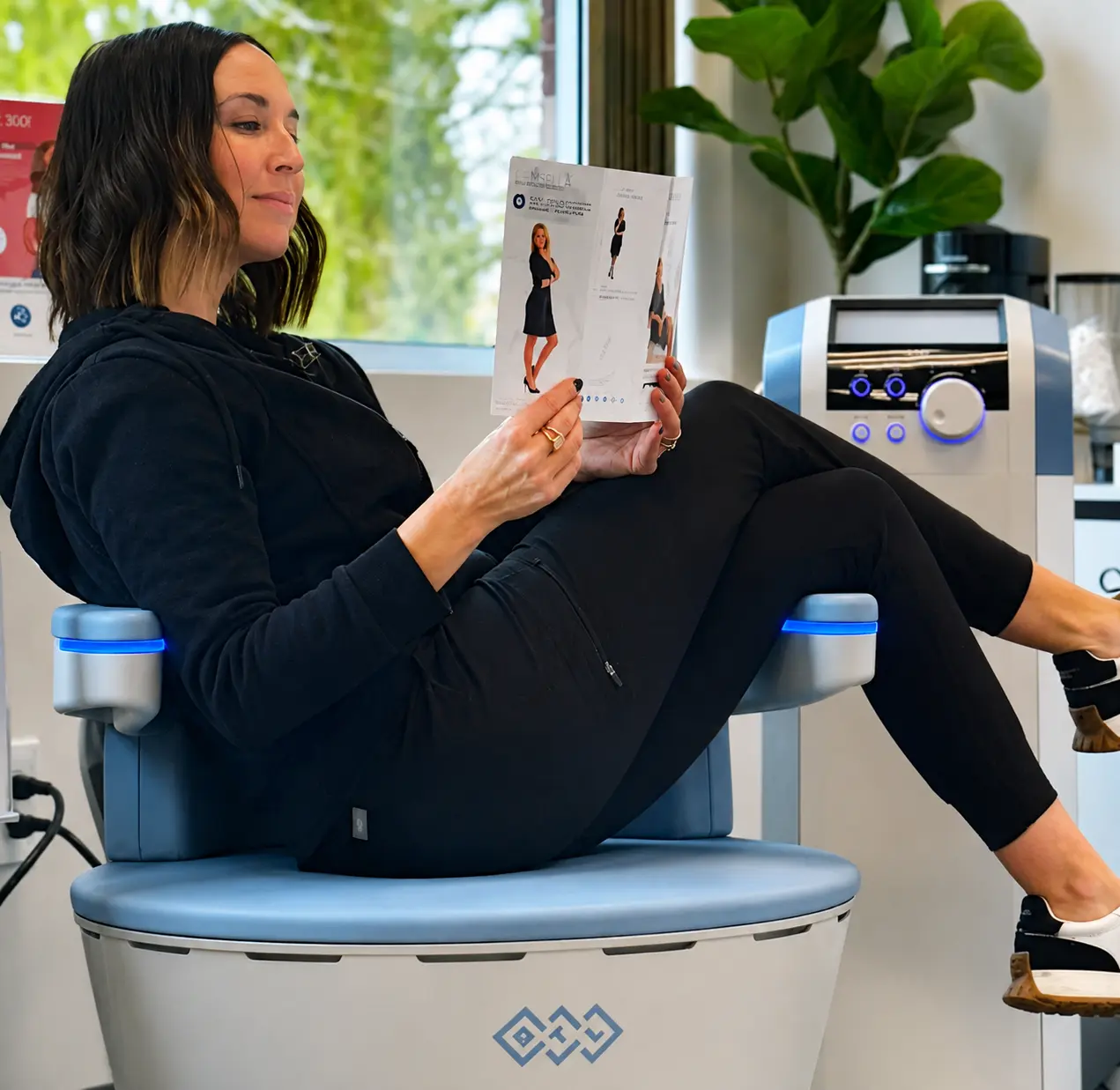
The Emsella chair treats a problem most people would rather not bring up, and it does it in a way that sounds almost too easy. You sit down, fully clothed, for about half an hour while the device works muscles you cannot reach on your own. Urinary leakage when you laugh or cough, or on the way to a bathroom you barely reach in time, is common, especially after childbirth or around menopause, and it quietly reshapes what people feel comfortable doing. It is far more common than its silence suggests, and it grows more likely with age. Emsella offers a way to strengthen the pelvic floor without surgery or recovery time. The two fair questions are how a chair can manage that, and whether the results justify the series of sessions it asks for.
What is the Emsella chair?
The Emsella chair is an FDA-cleared medical device that strengthens the pelvic floor using High-Intensity Focused Electromagnetic energy, usually shortened to HIFEM. You sit on it fully clothed, and over roughly 30 minutes it drives the pelvic floor through thousands of deep contractions, the equivalent of about 12,000 Kegel exercises in a single session.
The pelvic floor is the sling of muscles that supports the bladder and bowel, and in women the uterus, and helps control the flow of urine. When those muscles weaken, the support loosens and leaks follow. Emsella in Hillsboro, OR targets that muscle layer directly, which is what sets it apart from the pads and workarounds most people reach for first.
Why does the pelvic floor weaken?
Pelvic floor weakness is wear and tear on a muscle group that carries a heavy load, not a personal failing. Pregnancy and childbirth stretch and strain those muscles, and the effects can surface years later. Around menopause, falling estrogen thins the supporting tissue and loosens the sling further. In men, prostate surgery is a common trigger, since the procedure sits close to the muscles and nerves that govern continence. Chronic coughing, repeated heavy lifting, extra body weight, and high-impact exercise all add pressure over time, and age contributes on its own, because muscle mass and tone decline everywhere, the pelvic floor included.
Why do so many people wait to treat these symptoms?
One of the most common things we see at Epion is patients who have quietly lived with bladder leakage or urgency for years, often after pregnancy or childbirth, around menopause, with age, or following prostate treatment. Many have come to treat these symptoms as normal, something to manage with pads and planning rather than something that can actually be addressed.
Part of what we value about offering Emsella is the conversation it opens. These are symptoms people are often embarrassed to raise, and being able to tell someone that non-invasive options may exist, and that they do not have to simply accept the problem, changes how the visit feels before any treatment begins.
How does the Emsella chair work?
Voluntary Kegels only reach the pelvic floor muscles you can consciously squeeze, and most people cannot recruit the deeper fibers or hold enough repetitions to build real strength. HIFEM gets around that. The electromagnetic field passes painlessly through clothing and skin and stimulates the motor neurons that fire the pelvic floor, producing supramaximal contractions, meaning contractions stronger and more complete than you could create on your own. That intensity is the whole point, since a muscle only strengthens when it is pushed past what daily use asks of it.
Across a 30-minute session the chair triggers thousands of these contractions back to back. That repeated, intense stimulation does two things a home routine struggles to. It rebuilds muscle tone, and it re-educates the neuromuscular control that coordinates the pelvic floor, so the muscles respond better when you cough or lift something. Over a series of sessions, that added strength and coordination is what brings the leaks down.
What does an Emsella session feel like?
A session is undramatic, which is a large part of the appeal. You stay seated on the chair, fully clothed, for about half an hour while it works. Most people describe the sensation as a deep tingling or a run of muscle contractions, and the treatment is generally well tolerated. There is nothing to recover from afterward, so patients usually head straight back to work or errands.
What an Emsella session involves You sit fully clothed, with no undressing and no preparation. The session runs about 30 minutes, during which you can read or scroll your phone. The sensation is a series of strong pelvic contractions, and most patients do not describe the treatment as painful. When it ends there is no downtime, so your day carries on as normal.
Who is the Emsella chair for?
Emsella suits a broad range of people dealing with pelvic floor weakness, and the shared thread is muscles that no longer support the bladder the way they once did. Good candidates include:
- Women with leaks that began after childbirth or around menopause
- Men working to regain bladder control after prostate surgery
- People with stress, urge, or mixed urinary incontinence
- Active people whose pelvic floor has weakened from high-impact training
Beyond incontinence, some patients pursue Emsella for pelvic floor support and intimate wellness. Its role in men’s pelvic health is worth its own section, which follows below. A consultation is the place to confirm the treatment fits your situation, which matters most if you have an implanted electronic or metal device in the pelvic area or you are pregnant, since those call for a different plan.
How many sessions does Emsella take, and when do results show?
Emsella works as a short series rather than a one-time fix. The common protocol is around six sessions, spaced two a week over about three weeks, though your provider may adjust the number to your symptoms. Because the muscles build strength cumulatively, completing the recommended series is important.
Some patients begin noticing improvement during the treatment series, often fewer or smaller leaks and a bit more control, while improvement may continue after completing the recommended series. Responses differ from person to person, so timelines vary. Muscle strength also fades without upkeep, so results are not permanent for most patients, and many keep them going with occasional maintenance sessions.
Timeframe | What you may notice |
|---|---|
During the series | Sessions feel routine and easy to fit in. Some patients notice fewer or smaller leaks partway through. |
After completing the series | Any improvement may continue for a time. Responses differ, so there is no single timeline. |
Longer term | Many patients report steadier bladder control in everyday moments like coughing or exercise. |
Maintenance | Occasional sessions help hold the result, since muscle tone fades without upkeep. |
A patient we treated One of our patients, a 40-year-old mother of three, came to us dealing with urgency and frequency she had long assumed were simply part of life after kids. After a course of Emsella, she saw significant improvement in her symptoms and told us she felt more in control of her day. This reflects one patient's experience, and individual results vary.
What does the research say about Emsella?
Emsella’s approach has clinical backing. In a study of 75 women with stress or mixed urinary incontinence published in Lasers in Surgery and Medicine, six HIFEM sessions produced a significant improvement in incontinence questionnaire scores and a measurable drop in daily pad use, and patients reported no pain or downtime (Samuels et al., 2019). Broader reviews of magnetic stimulation for incontinence point in the same direction, while noting that outcomes vary from person to person.
As with any treatment, study averages describe groups, not individuals. How much Emsella helps you depends on your starting symptoms and what is driving them.
Does Emsella help men?
Pelvic floor problems are not a women’s issue alone, and Emsella is an important option in our practice for men. The same muscles that support the bladder also play a role in continence and sexual function, so strengthening them can help on more than one front.
The most established use in men is urinary incontinence, particularly after prostate procedures such as a prostatectomy, which can weaken the muscles and nerves that control the bladder. Research in men recovering from prostate surgery has reported meaningful gains in bladder control from HIFEM sessions, and because the treatment is non-invasive, it appeals to men who would rather not take on another procedure.
Pelvic floor strength is also tied to erectile and sexual function, since those muscles support the blood flow and rigidity involved in an erection. Pelvic floor muscle training has long been studied for erectile dysfunction, and early research on HIFEM in men has reported improvements in erectile and orgasmic function, particularly for milder issues linked to pelvic floor weakness. The evidence in this area is still developing, so we present it honestly as a supportive option rather than a guaranteed fix, and a consultation is the place to work out whether it fits your situation.
How does Emsella compare with other pelvic floor options?
Emsella is one of several ways to approach a weak pelvic floor, and seeing where it sits makes it easier to judge whether it earns its place.
Approach | How it works | Invasiveness and downtime | Best suited for |
|---|---|---|---|
Emsella (HIFEM) | Electromagnetic energy drives supramaximal pelvic floor contractions | Non-invasive, no downtime | Pelvic floor weakness and urinary incontinence when non-invasive muscle stimulation is clinically appropriate |
Kegels at home | Voluntary contractions you perform yourself | None | Motivated people who can isolate the right muscles and keep at it |
Pelvic floor physical therapy | Guided training and biofeedback with a therapist | None | Those who want coaching and a program built for them |
Medication | Drugs that calm an overactive bladder | Non-invasive, possible side effects | Urge-predominant symptoms |
Surgery, such as a sling | Surgical support for the urethra or bladder | Invasive, real recovery | Severe or structural cases that conservative care has not helped |
These approaches do not necessarily compete with one another. Many patients combine them, using Emsella to build pelvic floor strength while continuing pelvic floor physical therapy or home exercises to maintain and extend the gains. The right mix depends on what is driving the symptoms, which a consultation can help sort out.
Is the Emsella chair worth it?
Whether Emsella is worth it depends on your symptoms, what is contributing to them, and what you hope to get from treatment. For patients dealing with pelvic floor weakness who want a non-invasive option without downtime, it can be an appealing choice. Treatment is performed fully clothed, requires no recovery time, and fits easily into a normal workday.
It is worth being clear-eyed about the limits too. Responses vary, the gains are not permanent without maintenance, and more severe leakage or a structural issue such as significant prolapse may call for a medical or surgical evaluation that muscle stimulation cannot replace. Emsella also depends on completing the full series, so a single session is not a fair test. Determining whether you are a good candidate is part of what a consultation is for, and it is where we work out what is driving your symptoms and whether Emsella is the right fit.
On cost, the value question usually comes down to how much the problem affects your daily life and whether the plan is one you will complete and keep up. Epion membership options can make an ongoing plan easier to manage, and a consultation gives you a straight answer on whether you are likely to benefit before you spend anything.
How do you get the most out of Emsella?
A few habits make the series pay off. Completing all the recommended sessions counts for more than any single one, since the strength builds cumulatively. Keeping up light pelvic floor exercises between and after treatments helps hold the gains, and easing the everyday load on the pelvic floor, through steady weight and not straining, gives the muscles less to fight. Patients focused on core strength sometimes pair Emsella with Emsculpt NEO in Hillsboro, OR, which works the abdominal muscles with related electromagnetic technology.
Planning your Emsella treatment in Hillsboro
Pelvic floor problems are common and manageable, and the first step is simply talking to someone about what you are experiencing. A consultation sorts out whether Emsella fits your symptoms and what results are realistic for you, along with how many sessions you are likely to need.
Epion Aesthetics and Wellness is located at 5035 NE Elam Young Parkway, Suite 100 in Hillsboro, Oregon. Call 503-713-5543 or schedule your consultation online to talk through whether the Emsella chair is right for you. You can also read what our Hillsboro patients say before you book.
References
- Samuels JB, Pezzella A, Berenholz J, Alinsod R. Safety and Efficacy of a Non-Invasive High-Intensity Focused Electromagnetic Field (HIFEM) Device for Treatment of Urinary Incontinence and Enhancement of Quality of Life. Lasers in Surgery and Medicine. 2019;51(9):760-766. onlinelibrary.wiley.com/doi/10.1002/lsm.23106
- Lukanovic D, Kunic T, Batkoska M. Effectiveness of Magnetic Stimulation in the Treatment of Urinary Incontinence: A Systematic Review and Results of Our Study. Journal of Clinical Medicine. 2021;10(21):5210. doi.org/10.3390/jcm10215210
- Evaluating the Efficacy of High-Intensity Focused Electromagnetic (HIFEM) Therapy for Postprostatectomy Incontinence in Men. Therapeutics and Clinical Risk Management. 2025. pmc.ncbi.nlm.nih.gov/articles/PMC12407011
- Brandeis J. Application of HIFEM Therapy Improves Orgasmic, Urinary and Erectile Function by Stimulation of Pelvic Floor Muscles. The Journal of Sexual Medicine. 2024;21(Suppl 1):qdae001.120. academic.oup.com/jsm/article/21/Supplement_1/qdae001.120